
Who is Our New Deputy Mayor? Mayor Fischer’s Background and Relevance to GHS
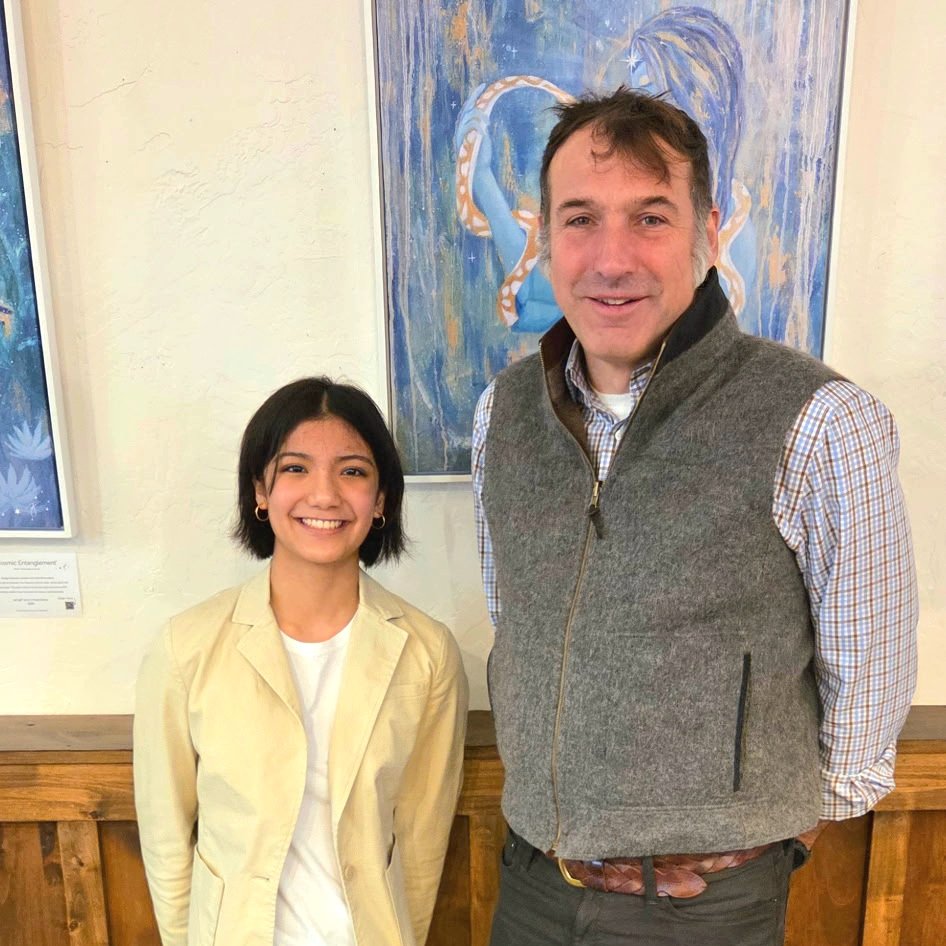
Maia Maganito and Mayor Douglas Fischer. Photo by James Paul Maganito.
Our new mayor loves coffee as much as you do.
No, seriously; during Deputy Mayor Douglas Fischer’s interview at Café M, across from the Bozeman Public Library, we both ordered our go-to caffeinated morning drinks. His usual order consists of half decaf, half regular, “so I can drink twice as much coffee, of course.” This moment in the local café shows his approachability and desire to connect with the community, especially with younger residents such as ourselves.
Fischer has been an active member of our community ever since he began his eight years on the Bozeman School Board. He was appointed to be a City Commissioner in 2023 and ran for mayor in November of 2025, winning with over 61% of votes. Due to the structure of Bozeman’s government, Fischer is now set to spend two years as Deputy Mayor before becoming mayor in 2028.
Though his important role in the city might seem intimidating to high school students, Fischer is far from lacking relatability to upcoming adults such as ourselves. Whether through our shared caffeine addiction or his goals in maintaining safety and the small town magic Bozeman has to offer, GHS students share more in common with him than one might expect.
Relatability is most commonly found through listening, especially as seen in his background in journalism. In this specific career path, he explains, “you have to be curious, question assumptions, and be able to tell stories… You also need to be able to listen. And I think listening is the most essential component of being a politician. People want to be heard.”
These listening skills acquired through Deputy Mayor Fischer’s background accentuate his belief in the importance of student voices. He mentions that innovative solutions for Bozeman’s future have been implemented as a result of listening to communication from students. Examples include Claire Vlases’ student-led initiative to advocate and raise money for solar power in schools, called Solar Makes Sense (SMS), which Fischer had a role in.
Movements such as SMS began with a single student’s attendance at a meeting of the School Board about a decade ago, where Fischer listened to a student perspective from Claire Vlases on the remodel of Sacajawea Middle School. Their conversation inspired Vlases to take initiative to make BSD7 more environment-friendly, contributing to the implementation of solar panels in schools throughout the district. Through this example, his emphasis on listening to the voices of our peers influences his decisions regarding high school students.
For high school students, this attentiveness and approachability in the local government impacts our daily lives. Whether this be from the safety of routes to school to the affordability of housing for recent high school graduates living in the city, Fischer is making sure that student voices are heard and taken into consideration.
Aligning with previous mayors’ goals, Mayor Fischer is prioritizing affordability, but through a different lens: job opportunities. Creating new ways for students to support themselves and their families can offset the rising costs of housing and education after high school. Fischer says this approach can ensure that Bozeman is a place to raise a family without the constant worry of unpaid bills.
Another topic relevant to students that Mayor Fischer aims to cover during his term is the safety of routes to school. Since many Bozeman students bike or walk home instead of taking a bus, busy streets like Oak can pose a safety hazard with heavy traffic flow.
“I would love, as we grow, that we think about having our bike trails and our parks separated from our big roads,” he says, “It’s much more about the parents of… someone going to elementary and middle school feeling comfortable opening the door and letting that kid go out there on their own. And [also] making sure that those pathways are plowed so that you can ride your bike in the wintertime.”
Moreover, Fischer emphasizes not only the physical environment of student life in Bozeman, but also the culture found in opportunities around town. “The school district is looking at increasing the amount of internship opportunities over at the Innovation Campus in various labs, and I think that’s very cool,” he says.
With Bozeman’s growing student population and our proximity to MSU, their lab technology and opportunities are highly accessible for high schoolers. MSU’s quantum computers and professional equipment have fewer students taking advantage of this than Fischer thought. “There are opportunities there,” Fischer says, “And as a high school student, you want to be curious [and looking] at different options.”
Through these internships and opportunities, student engagement is very important to Fischer, as he finds it crucial to make lasting changes in our community.
“If there’s something that’s not working or you’re unhappy about, it would be helpful to hear that. You have tremendous power in advocating for change, like Claire Vlases and the solar panels, [who] made a huge difference in the school board, district, and community.”
Standing by this sentiment, student perspectives will remain an important part of Mayor Fischer’s decision-making. As Bozeman grows, the local government will continue to determine many aspects of the lives of younger residents, further enforcing the idea that high schoolers’ voices are an important part of our community. Deputy Mayor Douglas Fischer looks forward to listening to and collaborating with residents of all ages for an inclusive future.
