
Legally Blonde

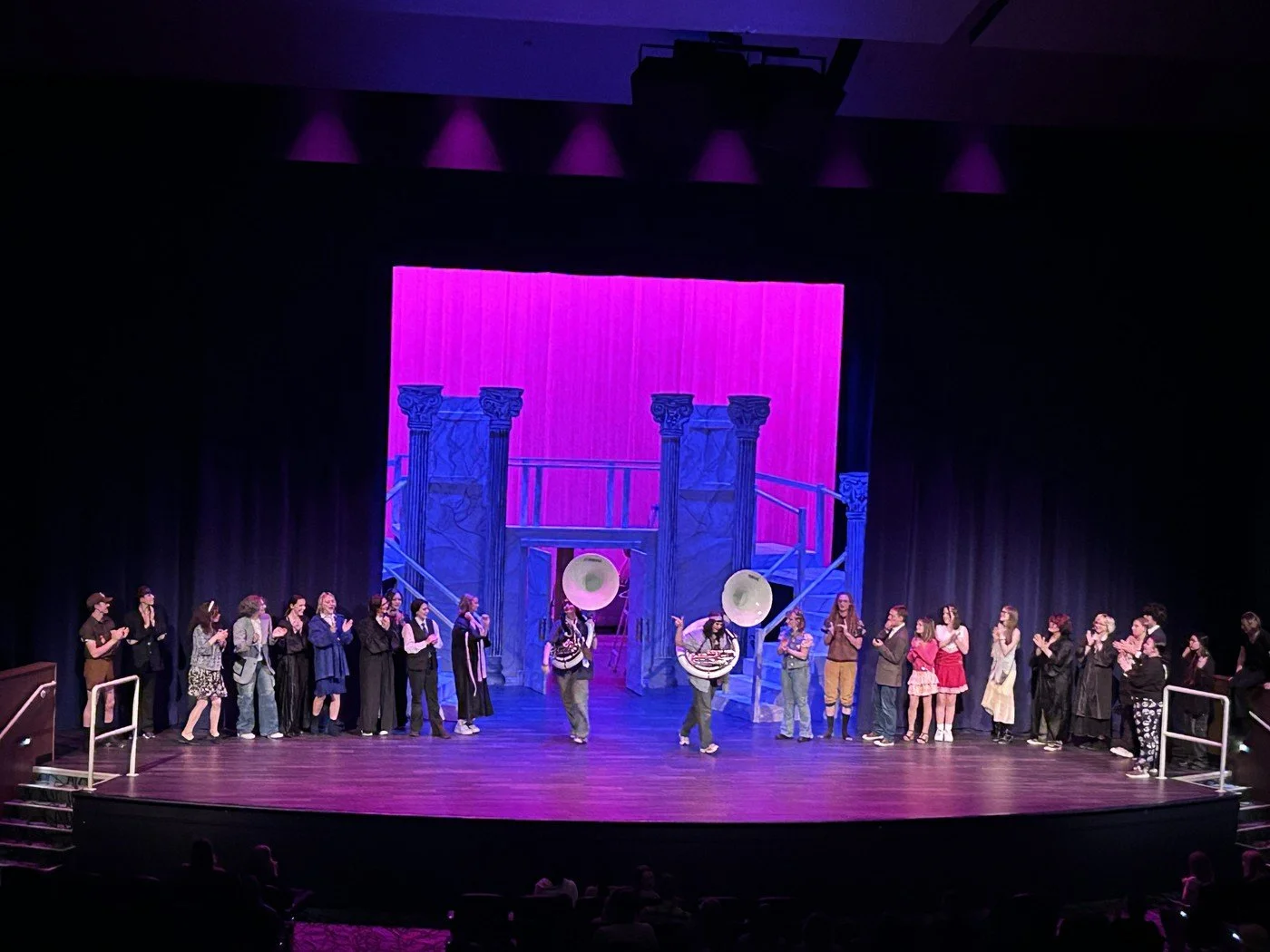
Cast members of GHS’s fall play, “Legally Blonde.” Photo courtesy of Erica Schnee.
Gallatin High School’s fall play lifted its curtain with youthful energy: Elle Woods, played by sophomore Heidi Loessberg, and her entourage sang the bubbly song “Omigod you guys!” with the enthusiasm that could only be brought by a cast mostly made up of underclassmen.
“Elle Woods has been my dream role for years,” said lead Heidi Loessberg, who practiced her singing roles by watching other amateur productions of “Legally Blonde.” Loessberg also choreographed Gallatin’s take on the play. While juniors and seniors played a variety of supporting and backstage roles, the set’s cohesion was not driven by older mentors but by the youth’s willingness to learn on set.
The GHS Thespians produced their rendition of “Legally Blonde” over several days in late November, bringing larger crowds than seen in past productions to the GHS auditorium. Because the play was created by a club rather than a class, students put in hours of work after school, some appearing on stage for the first time.
Junior Daniel LeCain, who played ‘Grand Master Chad,’ said the younger cast “gave us a lot more motivated and really fun students to work with on set.” LeCain, himself, had to find the motivation to step into a second role late into the production, becoming a human dog after the Thespians ruled the prospects of casting a real dog a logistical nightmare.
Senior Peyton Lewis commented that a younger cast came more eager to learn, an environment that fostered excitement for older teens. “I’ve made so many friends…and I want to do theater in the future. I love it so so much,” Lewis expanded.
Miles Meinders said the play allowed him to step outside of his comfort zone. According to Meinders, “I showed up to the singing [audition] and completely bombed the ever-living crap out of it,” something that led the senior to play a flirty UPS man named Kyle who does not sing.
The cast agrees that the biggest challenge surrounding the performance was communication. Loessberg said that the students received physical copies of their script a week before the final play and practiced songs without a music track behind them due to funding issues. “We got it down last minute,” LeCain said, referencing the stress accompanying such struggles.
While the performance, at least on the night I watched, was riddled with students forgetting lines and substantial issues with mics and sound levels, enthusiasm shone through. Parents and friends laughed in the audience, especially when the cast made the play interactive. At one point, the lights flick on to reveal an actor in the audience, and at another, Meinders’s character struts through the crowd, asking for directions. Just like the play’s conclusion, in which Elle carves a place for herself in the world, “Legally Blonde” was an exploration into how imperfection can create a beautiful, individualistic thing.
