
The Future Phone Ban and What’s Really Happening
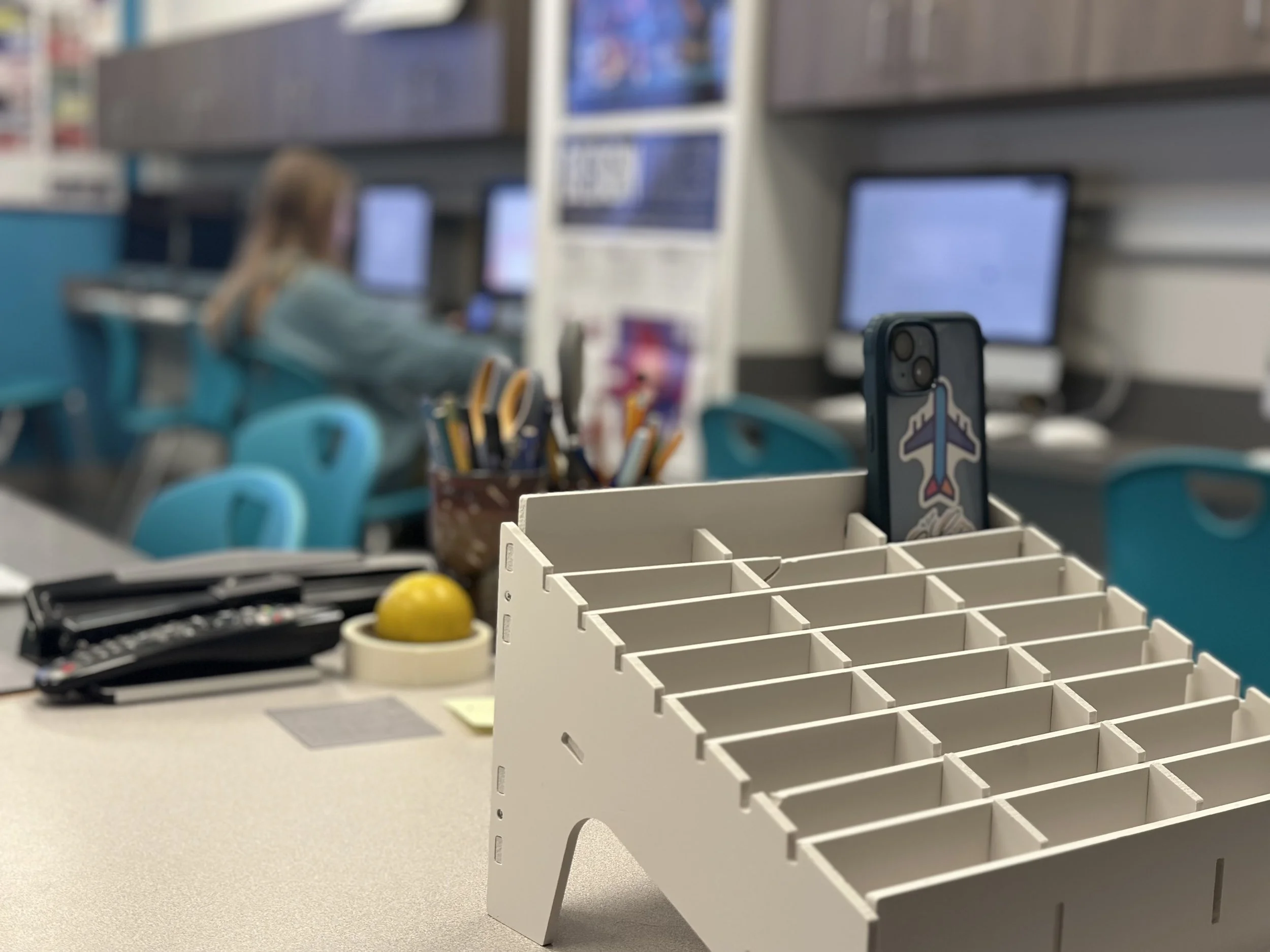
A lone phone in one of Gallatin’s many phone cubbies. Photo by Bridger Warner.
Earlier this school year, Cindy Reuter emailed Gallatin High School students and parents. She detailed that the student well-being policy adopted by the Board of Trustees would expand to effectively ban cell phones during school hours. Within a day, fears and questions arose about the future of Gallatin High School.
School boards across the country are struggling to manage the growing impact of student cell phone use. Many districts now employ complete phone bans, device confiscation, and Yonderpouches to address the social consequences of teen phone use. The Bozeman School Foundation is reconsidering policies to directly address student anxiety and health concerns.
Two years ago, the Bozeman school district reviewed its Long-Term Strategic Plan, which prioritized student well-being among its long-term goals. Thus, the Bozeman School Board established a committee to investigate the factors that influence students' well-being. Reflecting on the committee's work, Gallatin High School Principal Erica Schnee noted, “That committee recommended that schools go phone-free.”
After the school board adopted its recommendation last spring, the phone ban will take effect at the start of the following school year.
“I hope both students and families embrace this opportunity to turn back time and reconnect in real life,” said Jenn Lammers, the executive director of the Bozeman Schools Foundation and Executor of the Walker Nelson Youth Resilience Fund, as well as a committee member who investigated the factors on student wellbeing last fall.
“Having participated in the Bozeman Schools District's Student Well-Being Working group last year, I can say that the District administration examined numerous factors shown to contribute to adolescent anxiety and depression. Cell phone use stood out as a major—and manageable—contributor,” said Lammers.
Both Schnee and Lammers emphasized that the cell phone ban aims to counter growing anxiety and disconnectedness among teenagers by encouraging real-life connections. However, many students challenge the rhetoric behind the ban, arguing that it undermines their well-being and school safety.
The book ‘The Anxious Generation’ is a major source for limiting student phone access during the school day. The book blames cell phones and social media for a sharp decline in youth mental health. It claims parents have protected children from real-world threats, but have not kept them safe from virtual threats. These threats lead young girls to overcompare themselves and boys to withdraw into digital worlds. The book calls for bans on social media and reduced cell phone use for children and teens.
Some students, however, are adamantly opposed to the phone ban and its potential to change their school lives and the flow of Gallatin High School.
Benton Little Dog, a Junior at Gallatin High School, leads UnitedStudents4Action, which is completely opposed to the phone ban and the communication disruptions it could cause. “Everyone is afraid of an emergency happening… It's too big a fear for everyone to go without a cell phone at this point. And we get teachers [having them, but] at least give us access to them. Everyone tends to abuse it. At the same time, we are at a point where we need [cellphones].”
Benton Little Dog has spoken of many options to prevent extreme policies: walkouts, protests, and even legal action are all on the table.
Rumors about the phone ban’s severity have spread around Gallatin High School. Many are confident the new ban will require phones to be turned in at the start of the day and that it will disrupt school life, though this has not been officially stated.
“They [admin] want to have them locked up in specific little cubbies or close campus… [so] then we have to retrieve them at the end of the day. It's not like ‘no phones, don't bring them to school,' " said Little Dog when asked about what he believes the implementation of the ban would look like.
Although fears of a closed campus and confiscated phones persist, little evidence supports students' greatest concerns about the future ban; as of now, implementation details remain unknown.
When asked about rumors of a severe phone ban and use of phone lockers or Yonderpouches, Erica Schnee said, “Where are those going to go? We're not buying phone lockers for every student.” Schnee adds, “that's not a logistically feasible idea… It's expensive [for all] 1500 kids….”
“The school, the board, the school district… We all want to spend more money on educating students than managing cell phones. And I don't think anyone sees that as the wisest use of school district money… and there is absolutely no discussion of closing the campus. I'd be so curious to follow where and who was the 1st person that said, ‘there’s going to be a closed campus.’ Or ‘they’re locking phones up’ and… how did that go to all the different people? ”
The school board has been eager to hear the public’s opinion on this issue and has sent surveys to teachers, students, and parents. Principal Schnee, too, has created a Student Advisory Council to get a read on the Student body’s angle on the new phone policy.
More than 500 survey responses are being reviewed by the School District to inform policy decisions. Principal Schnee informed, "We are still in the initial planning phase, but all feedback will guide our next steps."
Principal Schnee also noted, “We want to be really thoughtful, intentional, ensure people are informed, and have opportunities to provide feedback. I appreciate our district's planning process. We're going to have community input. I really appreciate that about our school district.”
In the coming weeks, the School District will provide more details about the phone policy as they explore affordable, practical solutions.
Yet, there are still no final answers about what the phone ban will bring. The School District has many options in front of them, but no decisions besides: come September 2026, phones will be banned at Gallatin High School.
