
Running Venezuela: Perspectives on Operation Absolute Resolve

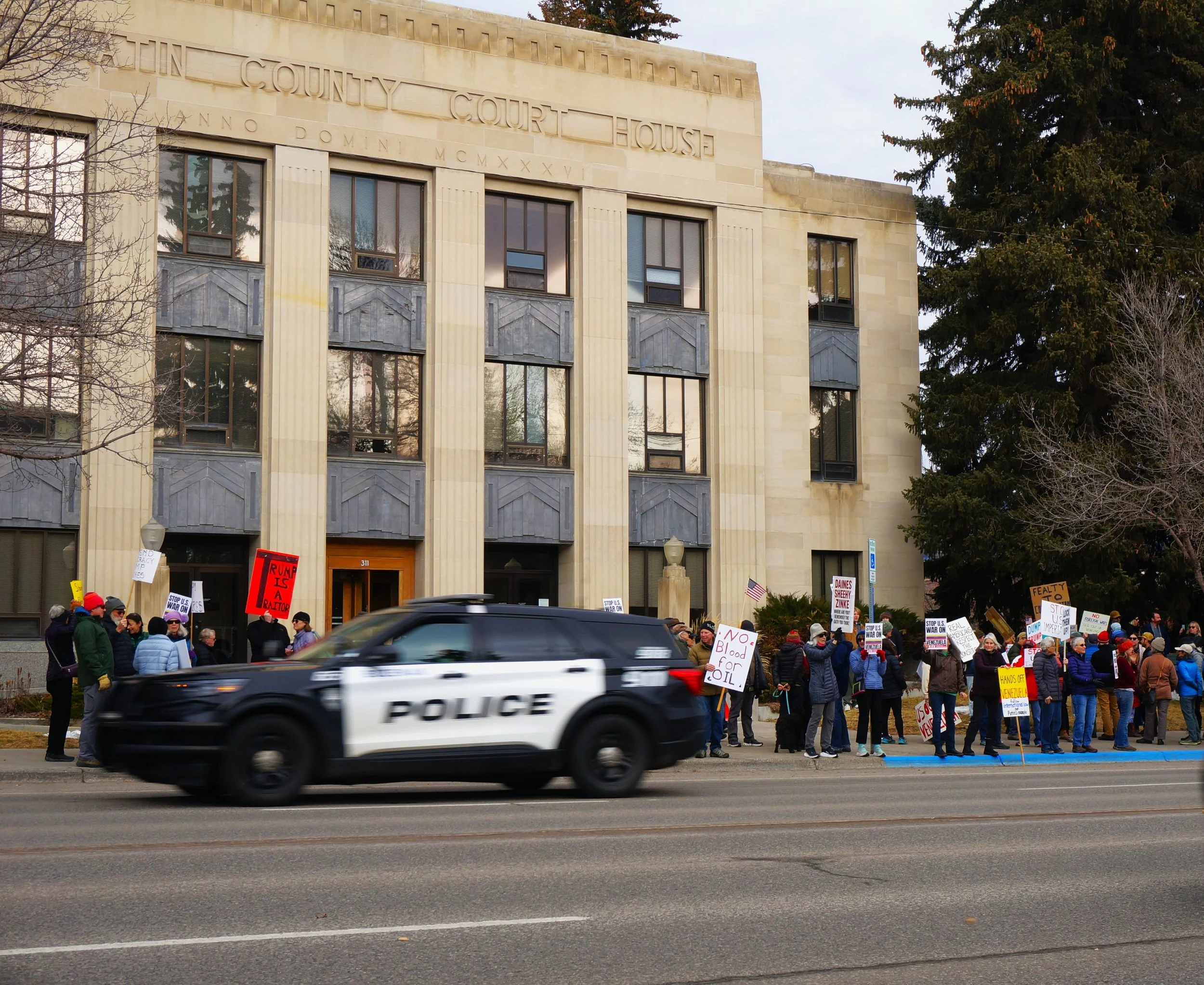
Protesters congregate in front of the Gallatin County Court House. Photo by Ezra Graham.
On January 3rd, the U.S. launched Operation Absolute Resolve, a fiery show of military force against Venezuela’s administration, ultimately leading to the capture of Nicolás Maduro, de facto president of Venezuela, and his wife, Cilia Flores.
María, a Gallatin High School student who came to the United States from Venezuela in 2022 as a political asylum seeker, views the Trump Administration’s deposal of Nicolás Maduro as a justified step in returning the country to democratic rule.
“My family didn't know,” said María, describing the U.S. government’s bombings of military infrastructure surrounding the capital city of Caracas. “There was no communication throughout the country that this was happening, and so we were the ones to tell them.”
Others oppose the American government’s actions. In a modest protest organized by Students for a Democratic Society, Bozemanites gathered at the Gallatin County Courthouse on Sunday, January fourth, to protest the American military’s actions. The crowd, mostly made up of senior residents or MSU students, peacefully walked from the courthouse to the post office on Babcock.
Regime change in Venezuela sparks complex political and historical debates surrounding the role of the American government in intervening in a country mired by poverty and corruption.
According to a UN report published in December, Venezuela’s Bolivarian National Guard perpetrated human rights abuses, which included “killings, arbitrary detentions, torture and sexual violence targeting protesters and opponents of President Nicolás Maduro.”
Paul Haber is a political science professor at the University of Montana, focusing on Latin America, social movements, and international relations. “When Chavez came into power in 1998, 1999, he won an election,” Haber explained. “[Chavez] was very popular for a number of years, and then as he consolidated power and started to concentrate power, he became increasingly unpopular with certain sectors of Venezuelan political and civil society.”
After the death of Chávez in 2013, Maduro came into power. Previously Chávez’s vice president, Maduro won the election by less than 2%, as reported by the Venezuelan National Electoral Commission (CNE). Maduro was declared the winner of Venezuela’s 2018 election as well, with most Latin American countries and the European Union labelling the results as fraudulent. According to Professor Haber, “Maduro took over and lacked the charisma, lacked legitimacy, lacked political skill that Chavez had.”
In 2024, Maduro ran for a third term against opposition candidate Edmundo González. González was supported by 2025 Nobel Peace Prize winner María Corina Machado, who was barred from running by Maduro’s government. Independent organizers contested the results verified by the CNE, showing González’s loss. The opposition sought to prove fraud by collecting actas, tally sheets produced by Venezuela’s electronic voting machines that track votes per candidate. Organizers collected actas from 80% of precincts, illustrating that González had won the election, receiving 67% of votes in the regions reached by organizers. Haber says corruption orchestrated by the Maduro administration was one reason for its decreasing popularity.
Jeff Ball, who attended the ‘No War in Venezuela’ protest, said he doesn’t know what to believe regarding Maduro’s legitimacy or “any of the recent elections globally,” highlighting the rise of electoral distrust.
On the contrary, Gallatin High’s María views American action in Venezuela as necessary because of Maduro’s undemocratic rule. “Venezuelans have tried and tried for so many years to try to make a change ourselves. We have never been allowed to make a change. We tried to go for elections, which were [rigged]. So many Americans are saying that they were not [rigged] and that the lawful president was Maduro, which is a complete lie.”
Haber agrees that an organic revolution was not likely to happen: “I didn't see a social movement there capable of overthrowing the Maduro regime, and that's why so many people, particularly in the diaspora, are celebrating this.”
From María’s experience, a fraction of Venezuelans still vote for Maduro because of the belief that the United States is to blame for the country’s plight. The student, who has family that voted for Maduro, said that many living in extreme poverty blame outside forces, like the U.S., for inflation. She says others who work for the government are guaranteed a higher standard of living and voted to continue that.
In a press conference after what the government described as a law enforcement mission, President Donald Trump proclaimed that he and a group of cabinet officials would “run the country.” When pressed by reporters, the Trump Administration clarified that Washington will control the Venezuelan government by proxy. After Maduro was captured and taken to New York to face an indictment, Delcy Rodríguez, the former vice president and Maduro loyalist, was declared acting president by the country’s highest court.
In the aftermath of the military action, analysts compared the extraction to the George H. W. Bush Administration’s toppling of Manuel Noriega in Panama. Haber cautions that the conditions of Trump’s actions are different. Panama, “was limited to taking [Noriega] out, and then the Panamanians took over.” Panama recovered a democratic government and grew economically. Yet, the prospect of years of an American shadow government in Venezuela changes the political popularity American governance will face.
After the operation, Donald Trump cited the Monroe Doctrine, President James Monroe’s foreign policy doctrine from 1823, which aimed to limit European influence in the Western Hemisphere. Mr. Haber views the Doctrine as a malleable document, interpreted differently–or neglected–by modern American administrations. During the Cold War, the U.S. saw the Doctrine as a justification to curb communism in the Americas. By the Clinton Administration, the United States seemed to reject the Monroe Doctrine, extending a more diplomatic, yet non-interventionist hand to Latin America. Haber says Trump is “resuscitating the Monroe Doctrine and reinstituting spheres of influence politics.
Those opposed to military action have been sceptical about the Justice Department’s charges against Maduro, which include allegations of narco-terrorism and conspiracy to possess destructive devices. Venezuela has served as a focal point for cocaine smuggling in Latin America, including in the region where María lived, where she says she saw drugs being smuggled. Yet stimulant drugs such as cocaine account for only 15% of American overdose deaths; fatalities are mostly centered around the distribution of fentanyl.
Speaking to protestors as they marched East on Main Street revealed that the most prominent targets of the protestors’ worry were related to the rule of law and exploitation of oil reserves. Storm Williamson, part of the Democratic Socialists of America, said, “the U.S. has been complicit in war crimes the past so many times, and I really don't want to see it happen again.” Williamson continued, “Ultimately, people in other countries have the right to self-determination. They should have been able to get rid of Maduro themselves if they wanted to.”
A protester named Katherine viewed President Trump’s operation as an act of war, which necessitates Congressional approval. “He has absolutely acted as an immoral criminal,” she said, citing boat bombings the administration has carried out in international waters, raising concerns over international law. Congress was not briefed before Maduro’s capture. “Congress is lame,” said Katherine. “It's up to all of us to get out and to say it's enough.”
Katherine also sees oil profits as a key American motivation. According to her, “Grifters in the White House are literally making money off of every single action that they take, and the American people are the ones that are paying for it and suffering. [Trump] is not representing and doing his job here, and he thinks he can do it in Venezuela.”
Venezuela once produced more than 3 million barrels of the commodity a day. As of late, it only produced 1 million, mostly sold to countries like Cuba or Russia that maintain diplomatic relations and do not sanction Venezuela. Professor Paul Haber says that “all the way back to before Chavez came to power, [Venezuela] was referred to as a petro state,” in which oil reserves dictated the political economy of the nation.
Venezuela’s vast oil reserves were cited explicitly by President Trump as a lucrative result of his administration’s action, and recently met with American oil executives. “Everything that [Trump] wants is just the oil, and that's okay. I have never really believed the fact that he says that he's there because of the drugs, or I don't think that he necessarily even cares about the Venezuelan people,” said María. “But I also think that he wants to do this so that he can take away a lot of the Venezuelan people in the United States, that they can go back to their country
About 8 million Venezuelans have left their native country since 2014, in what the UN Refugee Agency labels “one of the largest displacement crises in the world.”
At the same time, “I don't see how all of a sudden…there's going to be some kind of bonanza coming out of the Venezuelan oil sector,” Haber cautions. “Maybe I'll end up being surprised, but it's going to take a lot. It'll be one hell of an effort if they do it.”
