
Beneath the Water’s Surface: Inside the Ennis National Fish Hatchery

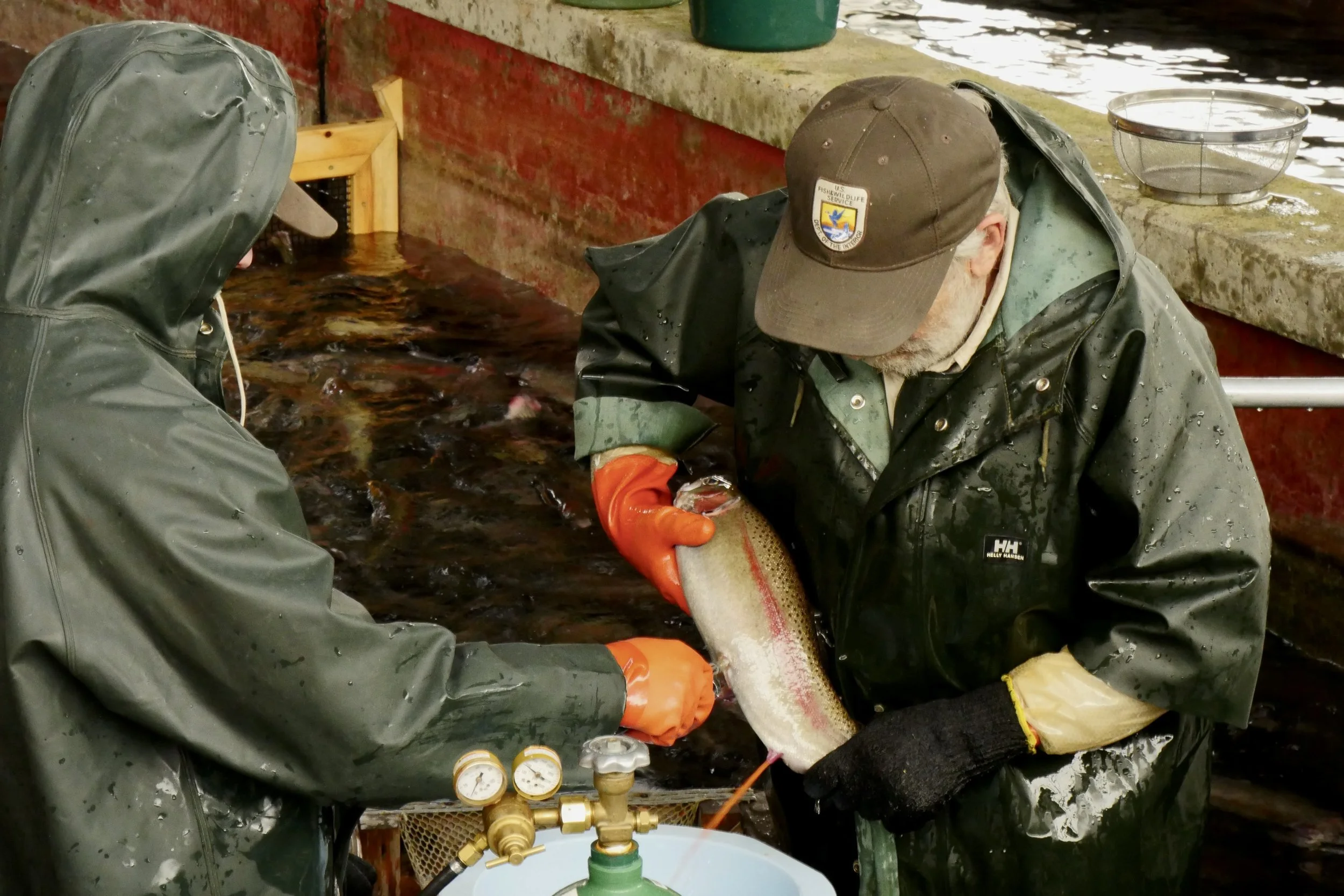
Hatchery staff inserting the needle into the body cavity, which pushes out the eggs. Photo by Isla Bute.
If you’ve ever cast a line in the Madison River and caught a shimmering rainbow trout, there’s a chance that fish was raised in the concrete raceways at the Ennis National Fish Hatchery. This facility, tucked away in Madison County, plays an enormous role in trout management both locally and across the country.
Gallatin High School’s Environmental Club recently had the opportunity to visit the Ennis National Fish Hatchery. It’s a facility that produces about 20 million rainbow trout eggs annually for research centers around the country, and 350,000 fingerling rainbow trout for the state of Montana.
There are 6 different strains of rainbow trout produced in the Ennis National Fish Hatchery. Since many other states don’t have naturally occurring species of rainbow trout, the Ennis Hatchery provides eggs for other facilities.
Amy Heiling, a fish hatchery technician, walked the club through the process of spawning. Two workers stood in the raceways in waist-deep water, decked out in rubber overalls to keep them warm and dry. This process occurs almost year-round, and during the busy season, workers are in the water completing this process for up to 8 hours a day.
Hatchery staff begin the spawning process by scooping up a fish from a divided section of the raceway. The wriggling fish are then set into a large bucket filled with a solution of tritane methane sulfonate. These chemicals slow the fish down, and temporarily put them to sleep.
Next, another worker uses a hypodermic needle attached to an oxygen tank. The needle is inserted into the trout’s body cavity and pushes all the eggs out of the depositor and into a mixture of saline solution. The milt (sperm) is then added and the fish eggs are fertilized. After the eggs are deposited from the body, the sleeping fish is tossed in a heaving arc through the air and into the next raceway over, landing with a splash. The fish aren’t harmed at all by this process, and wake up within minutes, swimming peacefully.
The Ennis National Fish Hatchery is important because it helps support healthy and sustainable trout populations, which in turn supports recreational fishing and ecological balance. The facility is also accessible to visitors which is important to education and community.
In regards to Gallatin’s Environmental Club, the visit allowed students to see the process and get hands-on experience in the field of fish management. The facility also allowed for Gallatin High’s Environmental Club to take some eggs back to the classroom, where they are currently being raised and looked after by club members and faculty advisor Trevor Nichols.
If you are interested at all in fish and wildlife management, or want to be involved in the process of flinging fish through the air, you might be eligible for a summer internship and other volunteer opportunities. For several years now, the Ennis National Fish Hatchery has been providing a group of high school students the opportunity to work with the Youth Conservation Corps (YCC) Program with U.S. Fish and Wildlife.
Students aged 15-18 have a chance to gain hands-on experience at a federal facility. The program runs from mid-June to mid-August. Participants will earn minimum hourly wage while completing tasks like fish feeding, spawning, grounds maintenance, and facility upkeep under the supervision of hatchery staff. This is great for resume building as well as networking within the federal government.
Overall, the experience of touring the Ennis National Fish Hatchery was insightful and productive. The fish will continue to grow and be observed by the Environmental Club, and the hatchery will keep providing eggs to facilities across the country. Next time you are out fishing, just remember to thank the hatchery for what might be your next big Rainbow.
