
Global Updates: Africa

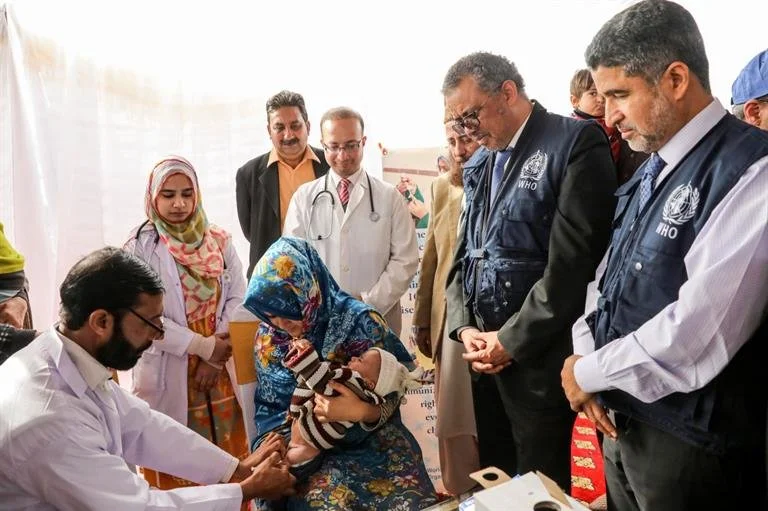
Dr. Ghebreyesus with the WHO, photo courtesy of A. Zaidi
As we rush through the canvas of our day with hasty brush strokes, let’s take a moment to zoom outwards to paint a clearer picture. In this new series of ‘Global News,’ each continent’s pressing issues will be spotlighted.
The opening continent of Africa has been undergoing tremendous procedures to eliminate polio, a once lethal disease that passed for developed countries. However, polio has yet to be fully eradicated. Indicated by Al Jazeera, an international news organization, the cause is stalled due to a lack of foreign funding, partially due to the United States’s withdrawal from the WHO, or World Health Organization. The Global Polio Eradication Initiative (GPEI) has continuously labored to accomplish their goal of reaching 125+ countries with vaccines, according to the National Institute of Health (NIH), but their budget may not allow for that. They have lost about 30% of their budget, resulting in an approximately $1.7 billion deficit. Since the lack of funding directly impacts medical supplies and transportation, their work has to be scaled down. But this creates an open question for the people who have an unforeseeable future. Jamal Ahemed, the WHO’s director of polio eradication mentions, “We need everybody to remain committed and ensure that no child is left behind.”
This lack of funding puts GPEI’s strategy of targeting high-risk areas in jeopardy. Further, with the major deficit in funding, the organization is not surveying low-risk areas. This puts people at risk for collecting mutations and variants, as shown in the 30 cases from Nigeria deriving from cVDPV type 2 poliovirus. This strain of polio is a consequence of weaker vaccines, according to the NIH. With the lack of vaccines in a certain area, herd immunity is less powerful. The Global Polio Eradication Initiative in Africa has played a major role in providing vaccines to small communities, growing resilience for people in a global perspective.
Transmission of polio is extremely fast under unsanitary conditions. Namibia and Mozambique recently found themselves in a country-wide epidemic, as evidenced by the National Institute of Health. Its particles are easily transferable if present near humans in unsanitary conditions. The Mayo Clinic states that ingesting contaminated water from feces, coming in contact with cough or sneeze particles, and a lack of handwashing after using the restroom all contribute to the spread of polio.
Here at Raptor Report, our goal is to educate students on important issues present in our world. Through ‘Global Updates,’ our mission is to foster global awareness. If you have any ideas for our next focus, please reach out by emailing raptorreport@bsd7students.org.
