
“Language Rich:” A Visit to BSD7’s Early Learning Center

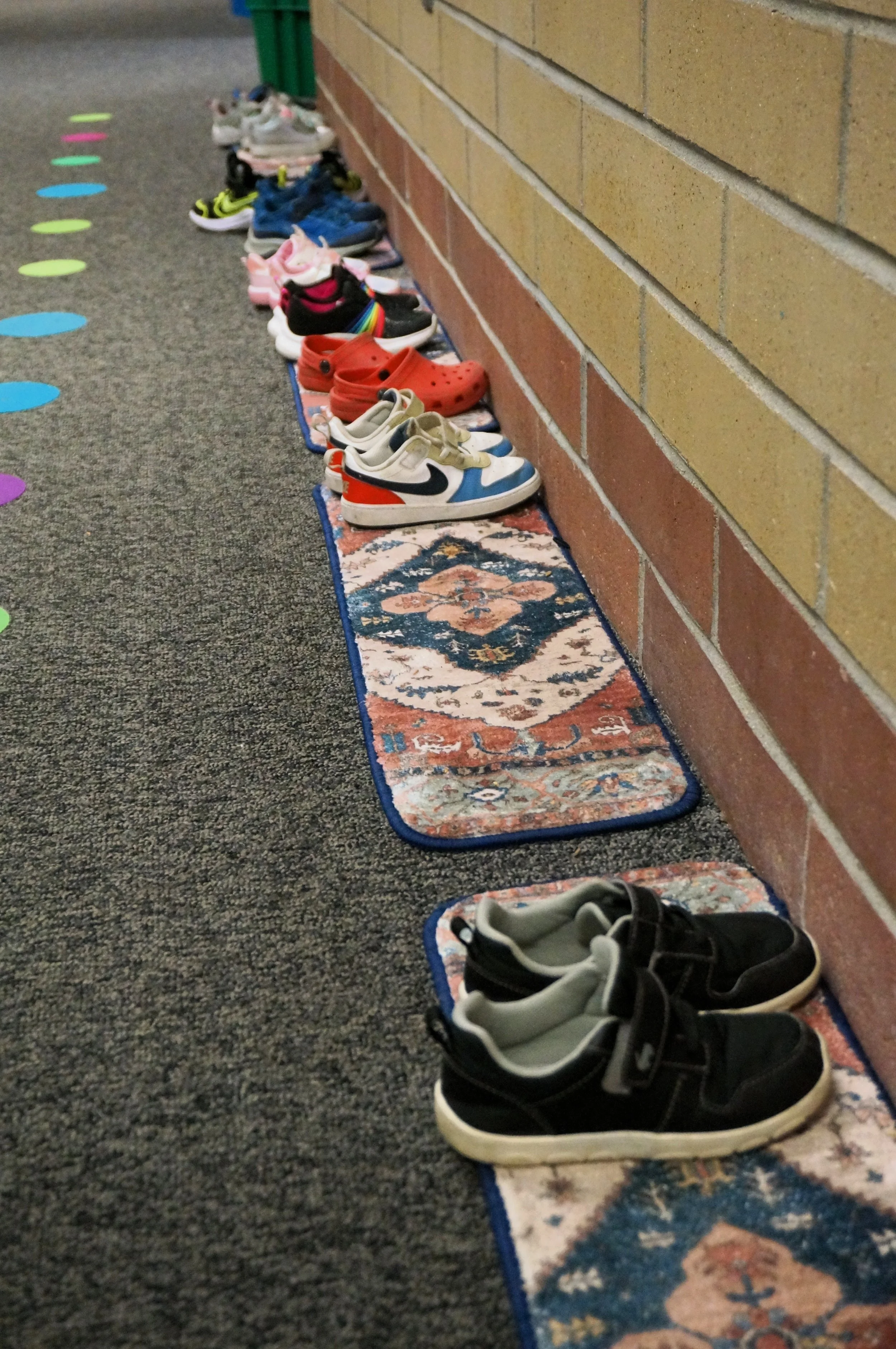
Shoes line the hallways outside of Morning Star’s pre-K early learning center. Photo by Ezra Graham.
In a sea of Gallatin High School seniors, many choose to wear small Pokémon, Cars, or superhero backpacks. Yes–teenagers want to be nonchalant. But the trend of those with facial hair toting an unserious pack to school reminds many of their time in preschool or elementary school.
At Morning Star Elementary School, which has become the bastion for an early literacy program, Gallatin’s students would feel at home.
The school’s Early Learning Center, opened in the fall of 2024, aims to remedy the lack of support given to students by a previous program called Running Start. The school also supports special education for three and four-year-olds, a service mandated by federal law.
Morning Star’s principal is Will Dickerson, an educator who worked previously in Las Vegas, Livingston, and at Bozeman’s Hyalite Elementary and Bridger Charter Academy. According to Dickerson, Running Start was hard for parents to access and for districts to run.
Now, House Bill 352, which passed with bipartisan support, allows Montana school districts to access funding to support early literacy initiatives, specifically for students identified as at risk of being illiterate by third grade. The Bozeman School District established Jump Start, a summer program to support children behaviorally and academically. To achieve this, BSD7 has established a screening process to identify eligible students.
A branch of Morning Star Elementary, previously made up of kindergarten to second-grade classrooms, shows the impact of money from Helena. Dickerson commented, “We put new bathrooms in this building. We hired teachers and paraprofessionals…And we started the program.”
Recently, Secretary of Education Linda McMahon visited Morning Star and Montana State University with Montana Governor Greg Gianforte. Morning Star’s administration characterized the visit as political by nature and said, “there isn't much to report as far as the visit.” “Locally-driven efforts show how returning education control to the states allows for tailored solutions that directly meet unique economic and community needs,” read a quote from McMahon on her visit to Montana.
The Early Learning program runs from Tuesday to Friday for a normal school day, allowing the many parents who work some reprieve. “Early intervention is kind of your biggest bang for your buck,” said Dickerson. “There's a lot of data that shows that literacy readiness at early grade levels is tied directly to your quality of living and actually even your lifespan.”
Research by Linda Mayes, a professor of pediatrics and psychiatry at Yale, said, “the more we invest in education, the more we're investing in children's health and a healthy community,” in a press release. Mayes’ research suggests that early literacy increases the social networks of youth and expands their worldview. Moreover, findings from 2006 published by UC San Francisco found that individuals with high literacy living with type 2 diabetes had better blood sugar regulation, even without a high school degree.
Demographically, Bozeman’s population has become more diverse: “About 20% of our students have another language other than English spoken in their home,” said Dickerson, of the makeup of early programming. Within this group, the majority’s native language is Spanish, with about four other languages in the mix.
The center also provides a math readiness curriculum, which may be less individualized because of the lack of a math screener for participants. “We know a lot less about how the brain learns math than we do about how the brain learns reading,” said Will Dickerson, on the challenge of administering such a test.
Because the center serves all of Bozeman, regardless of the elementary school they will attend, teachers have been seeing results. A teacher survey found that most ranked participants in the ‘average’ to ‘above average’ categories for social and behavioral readiness in the classroom. Further, as last year’s 72 participants grew to 90 this year, staff are expecting to see compounding positive impacts.
Briefly dropping into a class yielded a squirmy, yet well behaved group of students, aided by a teacher poised at an electronic whiteboard and a paraprofessional sitting with students.
Will Dickerson described a typical day: “We teach them toothbrushing in the classroom. They will eat breakfast or at least a snack in the room in the morning. Then there's carpet time and literacy time.” Singing the alphabet and reviewing the calendar, an introduction to numbers and math, gives young students a way to relate to content. A “language-rich, sound-rich, literacy-rich environment” invites students to dissect words into sounds to see the “science of reading.”
140 BSD7 students start kindergarten with tests indicating unreadiness, according to Dickerson. These numbers indicate that about 36% of such students are not receiving early instruction. The district’s program seeks to scale from five classrooms to six in the near future.
Before graduation, when seniors visit the elementary schools at which they learned to read, only height will distinguish them from the sea of preschoolers with identical backpacks. It’s yet another full-circle moment in education.
Ezra Graham attended Morning Star Elementary from kindergarten to fourth grade before the founding of the Early Learning Center.
